
Introduction
For any vehicle manufacturer in India, compliance with the Central Motor Vehicle Rules (CMVR) is non‑negotiable. The CMVR type approval process ensures that vehicles meet safety, environmental, and performance standards before they can be sold or registered.
This guide breaks down the step‑by‑step process of vehicle homologation in India, highlighting costs, timelines, and strategies for OEMs and EV startups
What is CMVR Type Approval?
CMVR type approval is the official certification that a vehicle complies with Indian regulations. It covers:
- Safety standards (brakes, lighting, crashworthiness)
- Environmental standards (emissions, noise levels)
- Performance standards (durability, efficiency)
Agencies like ARAI, ICAT, and GARC conduct testing and issue type approval certificates.
The CMVR type approval process in India is crucial because it ensures that every vehicle meets the country’s safety, environmental, and performance standards before entering the market. Certification under the Central Motor Vehicle Rules (CMVR) allows vehicles to be legally registered, sold, and trusted by consumers. It also guarantees compliance with Bharat Stage emission norms, safety regulations, and specialized requirements like AIS‑038 battery safety for electric vehicles. For OEMs, type approval is not just a regulatory step but a gateway to credibility, market access, and eligibility for government incentives such as FAME‑II EV subsidies. Without it, vehicles cannot be registered with RTOs or legally sold in India, making the process indispensable for both compliance and business success.
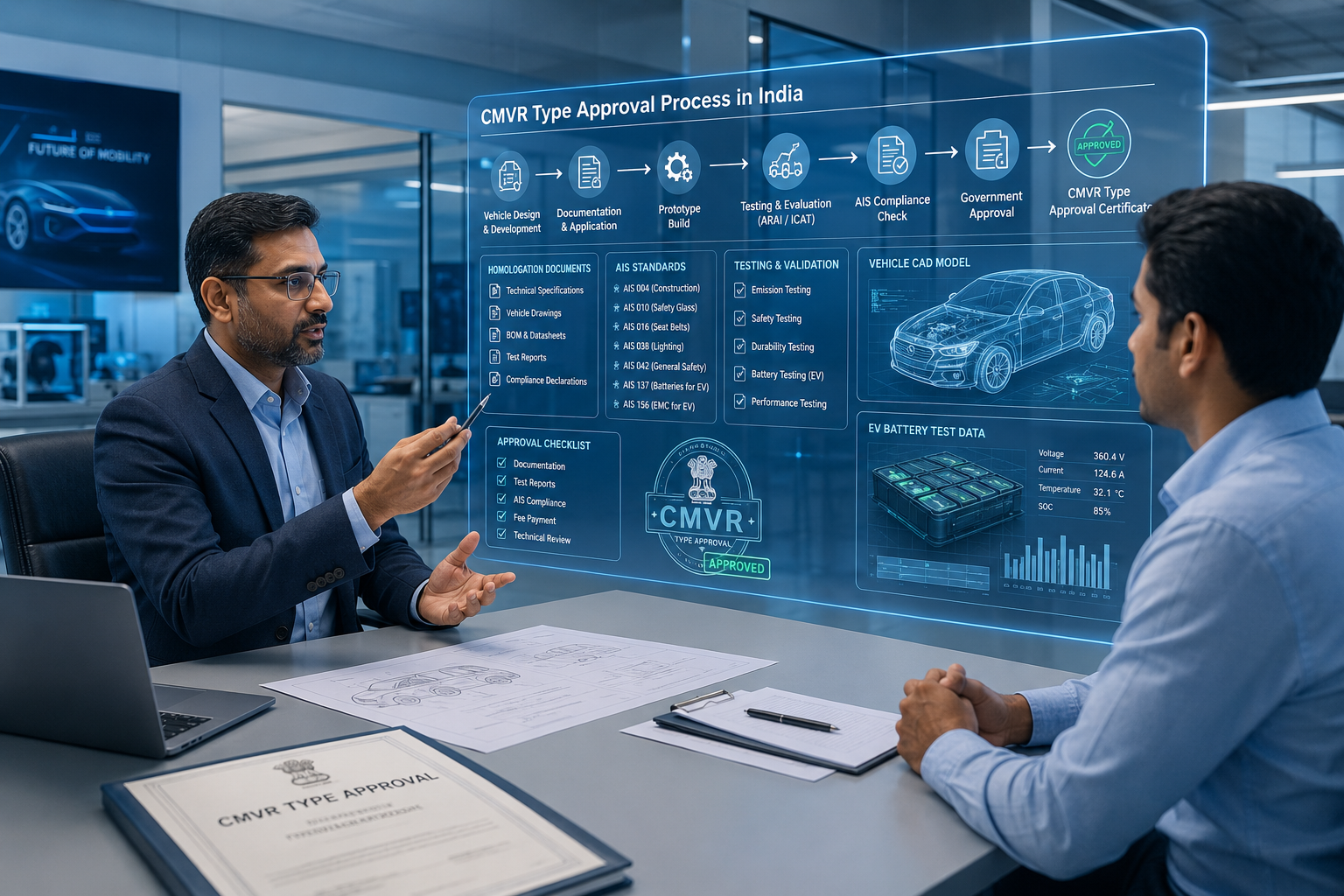
Step‑by‑Step CMVR Type Approval Process
Step 1: Application Submission
OEMs submit technical documents, design drawings, and compliance reports to the testing agency.
Step 2: Component Testing
- Battery safety (AIS‑038) for EVs
- Motors and controllers
- Lamps, mirrors, tires
Step 3: System Testing
- Braking efficiency
- Lighting and signaling devices
- Emission standards (Bharat Stage norms for ICE vehicles)
Step 4: Whole Vehicle Type Approval (WVTA)
Final certification for the complete vehicle, covering all systems.
Step 5: RTO Registration
Once certified, vehicles can be registered with RTOs and legally sold.
Cost of Vehicle Homologation
| Vehicle Type | Approx. Cost | Notes |
| Passenger Cars | ₹8–12 lakhs | Includes emission + safety tests |
| Commercial Vehicles | ₹10–15 lakhs | Higher due to load & safety |
| 2‑Wheeler EVs | ₹3–5 lakhs | Battery + motor testing |
| Low volume production homologation | ₹2–4 lakhs | Streamlined testing, but still mandatory |
Timelines
- Average duration: 2–4 months
- Factors affecting timelines:
- Complexity of vehicle systems
- Availability of test facilities
- Documentation accuracy
Challenges for OEMs
- High upfront costs for testing and certification
- Time‑consuming process with multiple stages
- Complex documentation requirements
- EV startups face additional battery safety compliance
How OEMs Can Streamline Approval
- Use certified components across multiple models
- Plan production volumes to spread costs
- Leverage subsidies for EVs under FAME‑II
- Choose the right agency (ARAI vs ICAT vs GARC)
- Maintain compliance records for audits
Conclusion
The CMVR type approval process in India is the gateway to market entry for OEMs. While costs and timelines can be challenging, certification ensures compliance, safety, and eligibility for subsidies. By planning strategically and leveraging certified components, manufacturers can streamline the process and reduce expenses.
About Devendra Automobiles Pvt. Ltd.
Devendra Automobile, based in Pune, Maharashtra, is a trusted consultancy specializing in vehicle homologation India, CMVR certification services, and compliance solutions for automotive manufacturers. With over 15 years of industry expertise, the company supports OEMs, importers, and suppliers in navigating complex approval processes with agencies such as ARAI, ICAT, and GARC. Devendra Automobile provides end‑to‑end assistance covering documentation, testing, and certification for 2‑wheelers, passenger cars, and heavy vehicles, along with specialized services for electric mobility components like batteries, chargers, displays, and motor controllers.
FAQs
1. What is the CMVR Type Approval process in India?
The CMVR Type Approval process is a mandatory certification procedure that ensures a vehicle or automotive component complies with the Central Motor Vehicle Rules (CMVR) before it can be manufactured, sold, or registered in India.
2. What are the key steps involved in the CMVR Type Approval process?
The process typically includes application submission, technical documentation, prototype evaluation, testing by an approved agency, compliance verification, and issuance of the Type Approval Certificate after successful testing.
3. Which testing agencies are authorized for CMVR Type Approval?
Government-approved agencies such as ARAI, ICAT, CIRT, GARC, and VRDE are authorized to conduct vehicle and component testing and issue CMVR Type Approval certifications.
4. What documents are required for CMVR Type Approval?
Manufacturers generally need technical specifications, engineering drawings, product details, quality documents, component information, test reports, and application forms required by the notified testing agency.
5. How long does the CMVR Type Approval process take?
The approval timeline depends on the vehicle category, testing requirements, document completeness, and regulatory review. Proper planning and expert consultancy can help reduce delays in the certification process.
6. Where can I get CMVR Type Approval consultancy in Kothrud, Pune?
If you’re looking for CMVR Type Approval consultancy in Kothrud, Pune, Devendra Automobile provides complete support for technical documentation, homologation, testing coordination, and liaison with government-approved testing agencies, helping manufacturers achieve regulatory compliance efficiently.
 Previous Post
 Next Post